

Write a 2,000-word post. Publish it. Watch it get three visits (two of them yours. If that sounds painfully specific, it’s because it happens to almost every new blogger, and the reason is almost never the writing. The post went hunting for a keyword nobody was searching for) or worse, one the internet had already answered perfectly.
Keyword research is how you avoid writing that post again. And despite what the tool vendors imply, it doesn’t need a paid subscription to start. What it needs is two honest questions, asked before you write a single word.
Keyword difficulty is a guess. Treat it like one.
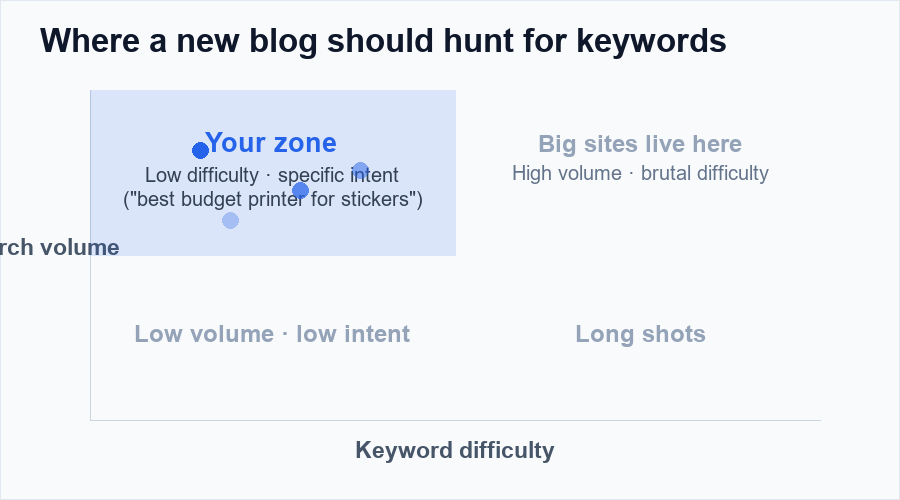
Every SEO tool shows a “keyword difficulty” score, and every tool computes it differently. The same keyword can score 32 in one tool and 61 in another; not because one is lying, but because difficulty scores are proxies built from backlink counts, and backlinks are only part of how pages rank.
So don’t filter your entire keyword list by a number. Use the score for one thing only: sorting your list from “probably easy” to “probably brutal.” Then verify the shortlist where the decision actually happens; the search results themselves.
The two questions worth asking
Before committing to a keyword, open an incognito window, search it, and ask:
- Does my page match what searchers want? If the entire first page is listicles and you planned a tutorial, the intent doesn’t fit. Pick the keyword your format fits, not the one you wish existed.
- Can I plausibly beat what’s there? Forums ranking on page one? Thin 400-word answers? A big brand that clearly didn’t want to rank for this (a support page, a random blog stub)? Those are openings. Five in-depth reviews from household names? Close the tab.
The free method: Google itself is the tool
Paid tools speed this up, but Google will hand you a working keyword list for free if you ask it properly:
- Autocomplete. Type your topic, then a letter. Every suggestion is a real query people type. Write down the ones that surprise you; surprise usually means gap.
- People Also Ask. Each of these boxes is a ready-made H2. Click three of them and the box rewrites itself; free infinite question research.
- Related searches at the bottom of the page. These tend to be broader sibling topics, useful for planning a cluster rather than a single post.
- The forum trick. Search your topic plus
site:reddit.com. Threads full of the same question, asked over and over, are demand with no good article attached to it. That’s the single cheapest content idea in SEO.
One keyword, one post, one intent
The quietest way new blogs hurt themselves is cannibalization: three posts all “about” the same thing, each too thin to rank, each stealing the others’ signals. The fix is a boring rule; before writing anything, search the keyword. If a post you already published could plausibly rank for it, update that post instead of writing a new one.
Keep a simple spreadsheet: keyword, intent, target post, status. It takes ten minutes a week and prevents the slow accumulation of posts that overlap and cancel each other out.
What to safely ignore
- Exact monthly volume. “720 searches/month” is a twelve-month average across a country-sized audience, not a promise. A keyword with 90 honest monthly searches that converts beats a 10,000-search term you’ll never rank for.
- Exact-match domains. Buying best-keyword-research-tools(dot)com does nothing in 2026 except limit what you can ever write about.
- The tool’s full suggestion dump. Tools will happily export 4,000 keyword ideas. Your blog can publish three strong posts a month. The filter that matters is the SERP check, not the export button.
Your next 60 minutes
Pick your blog’s main topic. Pull ten keywords from autocomplete and People Also Ask. Search each one, apply the two questions, and keep the two or three that pass. That’s your next month of writing; and it took an hour, not a subscription.
Once you’ve picked a keyword, the next job is making the post itself deserve the ranking. Start with these on-page SEO techniques, and if every keyword on page one looks untouchable, read how to find low-competition keywords on a brand-new blog; it’s the same method, pushed further.
Frequently Asked Questions
Do I need a paid keyword tool?
Not to start. Autocomplete, People Also Ask, and the SERP itself will fill a month’s calendar. A paid tool earns its keep later, when you’re managing 50+ posts and want bulk difficulty data; not before you’ve written anything.
How long before a new post ranks?
New domains usually see first impressions within 2-6 weeks and meaningful clicks in 2-4 months for low-competition terms. If a post has had 90 days and zero impressions, the keyword was probably tougher than it looked; rewrite the title and intro, then wait another cycle.
Keep going: if every keyword on page one looks untouchable, find low-competition keywords on a brand-new blog, and once the post is drafted, run it through the 10-minute fact-check routine before it ships.