

A brand-new blog going after “best laptops” is a rowboat challenging a navy. The fight isn’t rigged against you; you’re just sailing into waters where the enemy has 12 years, 40 writers, and 90,000 backlinks. Low-competition keyword research is simply the art of choosing a different beach to land on.
Here’s what actually works when your domain is three weeks old and has the authority of a damp napkin.
Go where the big sites aren’t
Content farms publish what search volume tools surface; which means the obvious keywords are automatically the most contested. The non-obvious keywords live in places tools don’t index well: forum threads, niche Discords, comment sections, and the awkward middle-of-funnel questions people ask before they know the right vocabulary.
That’s not a limitation. It’s the whole strategy.
The forum trick (still undefeated)
Search your topic plus site:reddit.com or site:quora.com. Now apply two filters:
- The same question appears more than once. Repeated questions are real demand, not a one-off curiosity.
- A forum thread ranks on Google’s page one. Google would rather rank a forum thread than the existing articles; that’s a confession that no good article exists.
When both are true, you’ve found a keyword with proven demand and no serious competition. Write the definitive answer (better organized than the thread, updated for this year, with actual structure) and you’re often ranking within weeks on a domain nobody has heard of.
The “for you” pattern
Take any broad keyword and slice it by audience. “Learn guitar” is untouchable. These are not:
- Learn guitar for adults with no musical background
- Best acoustic guitar for small hands
- Guitar practice routine for 20 minutes a day
Each slice has lower volume, sure. It also has lower difficulty, a reader who feels the post was written for them personally, and (the part nobody mentions) higher affiliate conversion, because a person searching “for small hands” is much closer to buying than a person searching “best guitar.”
Raid the alphabet
Old-school but it keeps working: type your seed keyword into Google followed by “a”, then “b”, then the rest of the alphabet. Autocomplete surfaces the awkward long-tails (comparisons, alternatives, “vs”, “without”, “cheap”, “near me”) that volume tools underestimate. Twenty minutes of this produces more rankable keywords than an hour inside any paid tool.
How to know you can win: the 4-check test
Before writing, run the keyword through this checklist. Three or more checks and it’s a go:
- ✅ A forum, Quora thread, or Reddit post ranks on page one.
- ✅ One of the top results is a thin answer, 400 words, no images, no structure.
- ✅ The ranking pages don’t quite match the intent (searching “fix blurry photos on phone” and getting desktop-software articles is an opening).
- ✅ No household brand has written the exact piece; or their version is from 2021 and shows.
When to walk away
Sometimes page one is five brands whose entire business is that keyword; comparison sites for “best web hosting,” for example. No amount of long-tail cleverness fixes that today. Bookmark it, revisit after your domain has a year of content behind it, and spend this week’s effort where the checklist passes.
The routine, condensed
Pick five keywords that pass the 4-check test. Write one post per week, each targeting one of them. Link each new post to one of your stronger articles, and give every post a shot at ranking by nailing the basics in this on-page SEO checklist. In three months you’ll have fifteen pages the navy never even noticed; and some of them will be quietly outranking it.
For the broader research workflow (including when to trust a difficulty score) read the complete keyword research guide.
Steal keywords from your own Search Console
The cheapest keyword source nobody uses: your existing data. Search Console’s Performance report shows queries where your site gets impressions but almost no clicks, Google already thinks you’re vaguely relevant, and readers are being shown to you. A query with 4,000 impressions and a 1% CTR is a page-two ranking waiting for a better title, a sharper intro, or 300 more words on the actual question. You don’t have to win from scratch; you have to finish the job.
The one-spreadsheet workflow
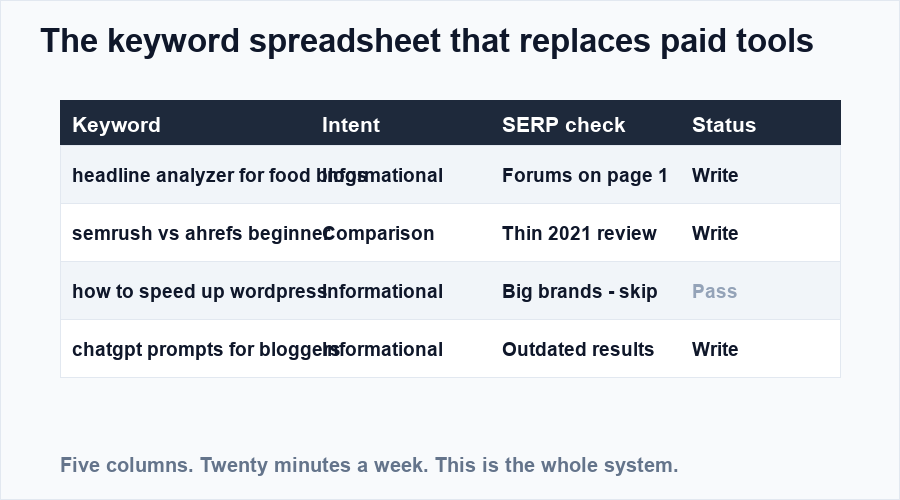
Everything above collapses into a single sheet with five columns: keyword · intent (informational / comparison / buying) · SERP check passed? · target post · status. Twenty minutes a week: add whatever autocomplete, forums, and Search Console surfaced, mark the SERP checks, and pull the next post from the top of the “passed” column. No dashboard needed. The bloggers who win at this aren’t the ones with the best tools; they’re the ones still doing the boring pass every single week.
Frequently Asked Questions
How low is “low competition,” really?
Not a difficulty score; a SERP observation. If any of the page-one results is a forum thread, a thin 400-word answer, or a big site ranking with an off-topic page, the competition is low enough for you. Scores vary by tool; observations don’t.
Is low volume wasted effort?
A keyword with 90 honest monthly searches converts better than a 10,000-search term you’ll never rank for; and ten such posts compound. Volume you can’t win is worth exactly zero.
Keep going: the broader workflow lives in the complete keyword research guide, and once a post is ready to publish, the on-page SEO checklist is what makes it deserve the ranking.