

An AI model has never once said “I don’t know” when a confident sentence would do. That’s the entire problem with publishing AI-assisted content unverified: the failure mode isn’t obvious nonsense; it’s fluent, well-structured prose containing statistics that were never real, quotes nobody said, and product details from a version of the world that doesn’t exist.
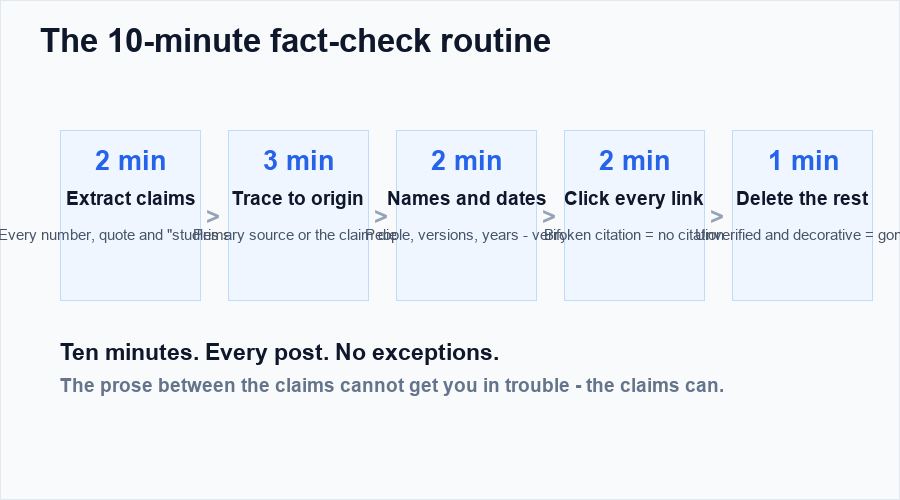
The fix isn’t avoiding AI in your workflow. It’s a routine; ten minutes, five steps, every post, no exceptions. Here it is.
Why the lies sound so good
Language models generate plausible text, not verified text. When you ask for a statistic, the model doesn’t look one up; it produces a string of digits shaped like every statistic it has ever seen, in the right format, with the right adjectives. The result feels true, reads true, and checks out false. Three patterns cover almost every hallucination you’ll meet:
- Invented statistics. “Studies show a 73% increase…”; no study, no year, no source. If a number appears with no citation, it’s decoration.
- Fabricated quotes. Attributions to real people that reverse their actual position, or to people whose only credential is sounding right.
- Stale-but-plausible facts. Correct for a world that existed in the training data; plugin settings, pricing, and limits from two years ago are the classic WordPress-blog version.
The 10-minute routine
Minutes 1-2: Extract every checkable claim
Ask the model itself: “List every factual claim in this draft that needs a source, as a checklist.” You’ll get 8-15 items: numbers, dates, product capabilities, “most experts agree” sentences. This list is now the whole job; the prose between the claims can’t get you in trouble.
Minutes 3-5: Trace numbers to their origin
For each statistic, find the primary source. Not “according to a study”; the study. If a search for the exact figure leads to other blogs citing each other in a circle and no origin, the number is hallucinated or garbage-copied. Either delete it or replace it with one you can link. A post with three verified numbers beats a post with fifteen decorative ones.
Minutes 6-7: Sanity-check names, dates, and versions
People: did they actually say or do this? Products: does the feature exist in the current version? Years: is “in 2026” doing any work that a real date should be doing? This is where fabricated quotes and outdated plugin interfaces get caught. Five minutes of searching replaces a reader comment saying “this is wrong.”
Minutes 8-9: Click every link
AI-drafted content often includes references; and references to pages that don’t exist, or that say something other than what’s claimed. Click all of them. A broken or mismatched citation is worse than none, because it signals nobody checked anything.
Minute 10: The deletion pass
For every claim still unverified, apply the only rule that matters: if it adds nothing, cut it; if it’s load-bearing, source it. Almost all hallucinated content is rhetorical decoration; “studies show” sentences that pad paragraphs. Your post doesn’t need them.
Make the standard visible
Readers forgive errors that get corrected; they don’t forgive carelessness that gets discovered. It’s worth stating your process publicly; we do, in our Editorial & AI Use Policy: drafts may be AI-assisted, every fact is human-verified. That one page does double duty as an E-E-A-T trust signal, and it forces you to actually keep the standard.
Pair this routine with the prompts from our ChatGPT prompts guide (several of them build the checklist automatically) and AI stops being a liability in your publishing workflow. It becomes what it should have been all along: a fast first draft, fact-checked by a human who signs their name to it.
When sources disagree
Sometimes two legit sources give different numbers; one study says 61%, another says 78%. Don’t panic-pick the one that fits your argument. Prefer the primary source over whoever cited it, prefer the newer over the older, and when the disagreement is real, say so in one honest line: “estimates range from 61-78% depending on methodology.” That sentence does more for reader trust than any single stat, because it shows you actually looked.
The claims table (do it once, reuse forever)
For posts heavy on data, keep a simple table in your draft; invisible to readers, invaluable to you:
| Claim in draft | Source | Status |
|---|---|---|
| “53% of mobile visits bounce after 3s” | Google/SOASTA research, 2017 | ⚠️ dated; reworded |
| “WebP cuts file size 30-50%” | Google WebP study | ✅ linked |
The habit catches the claim that “felt right” and quietly had no source at all; the one that would have survived five read-throughs and embarrassed you later.
Frequently Asked Questions
Isn’t ten minutes per post slow?
Compare it to the alternative: one inaccurate stat cited by a reader, screenshotted, and posted where your other readers see it. Ten minutes is the cheapest reputation insurance in publishing.
What about quotes the AI generates?
Assume every quotation is invented until you find the primary source; a real interview, a transcript, a video. If you can’t find it in two minutes, the quote comes out. No exceptions, even when it’s a great line.
Keep going: the prompts that produce checkable drafts are in the ChatGPT prompts guide, and the transparency page that ties the whole process together is our Editorial & AI Use Policy.