

A number on a tool screen decides most link building: the pitch goes out, the link comes in, and the only thing anyone checks is that three-letter authority score. DR 60, great. Done. Except that score tells you less about whether the link will help than almost any other fact about the page, and sites with mediocre numbers outrank “strong” ones every single day.
Before you spend a single hour chasing a link, run it through the five checks below. The whole evaluation takes four minutes, and it is the difference between a link profile that compounds and one that just gets bigger.
Check 1: Does the site actually talk about your topic?
Relevance is the first thing Google evaluates about a link, and it beats raw authority. One link from a cooking blog pointing at your recipe post carries more weight than ten links from tech sites, because the linking context tells Google what your page is about.
The practical test: read the site’s last ten headlines. If your article would look natural sitting among them, you have relevance. If it would look bought, Google will read it the same way.
Check 2: Does the site rank for anything real?
A site with zero organic visibility has usually been filtered out of search entirely, and a link from a filtered-out site is close to worthless no matter how impressive its authority score looks. Plug the domain into any free tool and look for keywords where the site ranks on page one or two. You are not auditing their whole business; you just want proof that Google trusts the domain enough to show it to people.
This is also where inspecting the prospect’s live site pays off: run the domain through our Website Theme Detector & CMS Checker to verify that it runs a real, well-maintained production stack, check that its pages rank for real queries in Google Search, and move on if the site looks like an abandoned link farm.
Check 3: Who else does this page link to?
A backlink inherits the company it keeps. Open the page that would host your link and scroll to the bottom. If the same page also links to casinos, essay-writing services, crypto-doubler schemes, or forty unrelated “sponsored” posts, the page is a link farm wearing a blog costume. Whatever authority it passes is diluted, and association with it is a net negative.
Healthy outbound profiles look boring: a handful of links, all topically sensible, mostly to well-known resources. Boring is exactly what you want.
Check 4: Where on the page will the link sit?
Placement is a multiplier that most people never evaluate. The hierarchy, from strong to weak:
- In-content editorial link, inside a paragraph of a relevant article. This is the real thing; Google treats it as a vote.
- Curated resource-page link, on a page whose job is to list useful things. Slightly weaker, still genuinely valuable.
- Author-bio link from a guest contribution. Real, but the same bio usually ships with every post the author writes, so its marginal value is small.
- Sidebar, footer, or comment links. Site-wide widgets and comment signatures carry almost no ranking weight in 2026.
When a “great opportunity” turns out to be an author-bio slot on a site that publishes ten guest posts a week, recalculate what it is actually worth before investing the writing time.
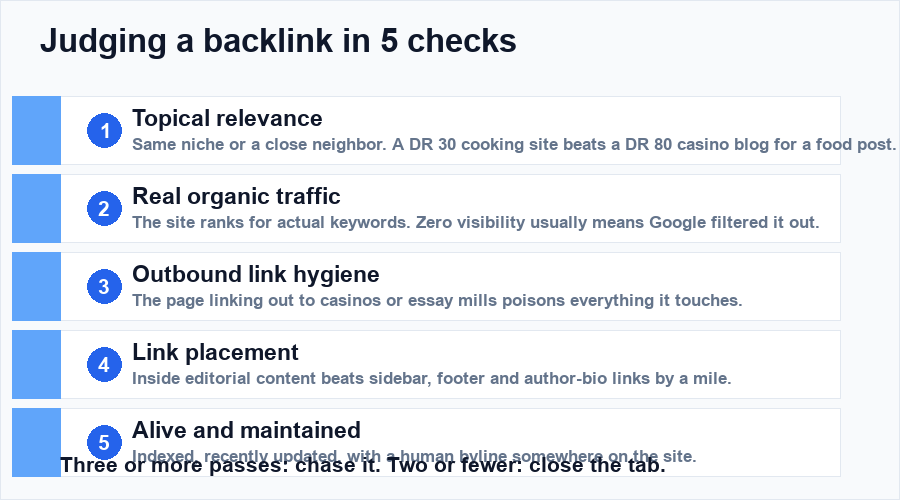
Check 5: Is the site alive?
The fifth check catches the graveyard sites that still show respectable numbers in tools: indexed recently, published something this quarter, has a human byline and a working contact page somewhere. A domain can hold its authority score for years after Google stopped sending it traffic, and links from those ghost sites quietly do nothing while your tracker shows a green uptick.
The anchor text paragraph you were going to skip
Once the link is secured, resist the urge to script the anchor. If every site linking to you uses the identical money phrase, the pattern itself becomes the signal Google’s spam systems look for. Brand names, bare URLs, “this guide,” and partial matches are what a natural profile sounds like. Say this out loud to anyone who writes your guest bios for you.
When a “good” link is quietly bad
Two traps catch even careful publishers. First, the undisclosed sponsored link: it feels like a win until you realize Google expects rel="sponsored" on paid placements, and an undisclosed one risks both parties. Second, the PBN pattern: several sites with different names, identical templates, thin content, and cross-linking to each other. They exist purely to sell links, and Google’s classifiers find them by exactly those fingerprints. If the “blog” has no real audience, no comments, no history, and suspiciously wants your article rather than your expertise, walk away.
Frequently Asked Questions
Do nofollow links matter at all?
More than their reputation suggests. Google treats them as hints rather than directives, they still send real visitors, and a natural link profile contains them. A nofollow link from a major publication is worth having; it just is not the same currency as a dofollow editorial link.
How many good backlinks does a new blog need?
Fewer than you think, if the checks above pass. A new post targeting a low-competition keyword typically starts ranking with a handful of relevant links, and content quality carries the rest. Chasing link count is how people end up with fifty worthless ones.
How long until a new link does anything?
Four to twelve weeks before rankings move, sometimes longer for a new page. That lag is normal. Judge a link campaign quarterly, never weekly.
Keep going: the strategy catalog is in the complete link building guide, the guest-post-free tactics are in backlinks without guest posting, and when you are ready to inspect the technology stack and CMS behind any authority domain in your niche, run it through our free Website Theme Detector & CMS Checker.