

The standard link-building advice is a grind: pitch a guest post, wait three weeks, get ignored, repeat. Twenty pitches for one published link, and the link usually points at your homepage from a site nobody reads. There’s a better use of those twenty pitches, and it doesn’t involve writing for strangers’ blogs for free.
All seven tactics below earn the same thing guest posting does (an editorial link from a real site) without the content treadmill.
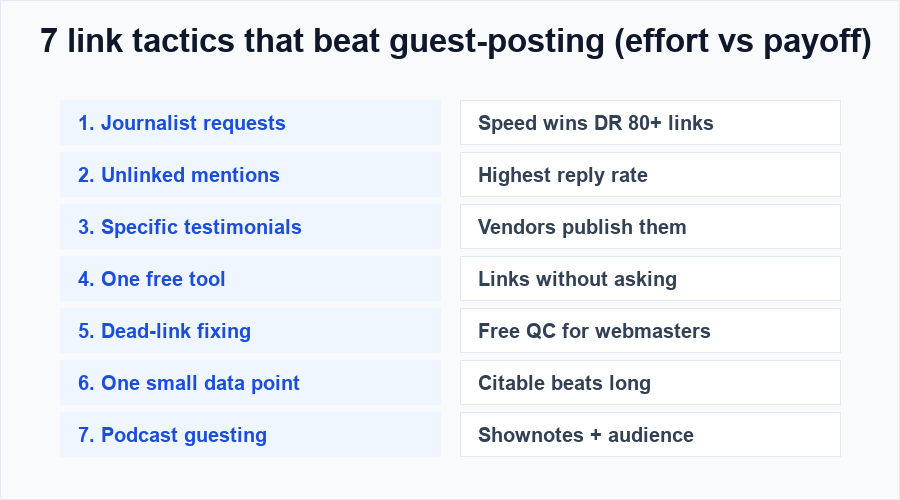
1. Answer journalists before they finish their coffee
Platforms like Connectively (the service that absorbed HARO), Featured, and SourceBottle connect reporters with sources. When a journalist from a major outlet quotes you, the link comes from a domain that makes your other backlinks look like stickers.
The catch is speed. Journalist requests get 50 replies in two hours. Reply within 20 minutes, lead with the actual quote (not your bio), and give them something specific enough to publish without editing; number, a contrarian take, a prediction. Generic “I’d be happy to share my thoughts” replies go straight to the trash.
2. Reclaim the mentions you already earned
Somewhere on the internet, someone has mentioned your blog, your tool, or your research without linking to you. They already did the hard part; they decided you were worth mentioning. Set alerts for your brand name (Google Alerts is fine for this), then send a two-line email: thanks for the mention, here’s the link if you’d like to add it. Conversion rates on this are absurdly high because the editorial intent already exists.
3. Write testimonials that vendors actually publish
SaaS companies display customer testimonials on high-authority pages, usually with a link to the customer’s site. The trick is specificity: “Great tool, highly recommend” gets deleted. “We cut our LCP from 3.1s to 1.4s in a weekend with this” gets published, with your link. Only testify for products you genuinely use. One fabricated testimonial is a reputation problem, not an SEO tactic.
4. Build one free tool (this is the unfair advantage)
Interactive tools collect links while you sleep, because bloggers and journalists link to useful things far more readily than to articles. This isn’t theoretical; our own Website Theme Detector & CMS Checker and WordPress Theme & Plugin Websites Finder earn reference links from developer and marketing blogs without a single outreach email. One genuinely useful lookup tool or interactive utility in your niche beats ten guest posts. If building isn’t your thing, start with a genuinely useful template or spreadsheet and give it a dedicated page.
5. Fix dead links on resource pages
Educators, associations, and newsletter writers maintain curated resource lists, and those lists rot. Find pages in your niche (intitle:resources plus your topic), scan for 404s, and email the maintainer a two-liner: your link X is dead, I have a current replacement. You’re not asking for a favor; you’re doing free quality control on their page. That’s why this converts.
6. Publish one small, real data point
You don’t need a 5,000-person study. “We analyzed 60 posts in our niche: posts with an FAQ block earned 2.3× more backlinks” is the kind of sentence journalists and newsletter writers cite because it’s small, specific, and quotable. Run a poll with your email list, analyze your own site’s data, or aggregate public numbers. Citable beats comprehensive.
7. Say yes to podcasts
Booking a podcast appearance is dramatically easier than booking a guest post; hosts are starved for interesting guests. Every appearance earns a shownotes link (usually dofollow), plus an audience of exactly the people who might link to you later. Ten niche podcasts will take one evening of pitches.
What quietly works against you
While you’re doing the above, don’t undo it: reciprocal link-exchange emails, “submit your site” directories, and AI-generated blog-comment spam all read as manipulation to Google now, and the sites that host them are toxic neighborhoods. One clean editorial link outweighs fifty of those.
Pick one. Give it 30 days.
Tactic-hopping is why most link building fails. Choose one of the seven, work it for a month, and watch your referring domains in Search Console, monthly, not daily. For the strategies that do involve outreach at scale, including broken-link building at volume, see the complete link building guide.
How to know any of this is working
Ignore total backlinks: one site can send 40 sitewide links that mean nothing. Watch referring domains in Search Console (the count of distinct sites linking to you), monthly, not daily. A healthy new blog earns 2-5 new referring domains a month with zero heroics; if three months pass at zero, the tactic you picked needs changing, not more of the same. And when a link does land, check where it points: homepage links are nice, but links to your actual best content are what move rankings.
One anchor-text caution
However you earn links, keep the anchor text natural. If every site linking to you uses the identical phrase “best keyword research tools,” that pattern itself becomes the signal Google’s spam systems look for. Brand names, plain URLs, and “this guide” are what an honest link profile sounds like; don’t script your way out of it.
Keep going: the full strategy catalog, guest posting included, is in the complete link building guide; and remember links only matter if the page they point at can rank; the on-page SEO checklist covers that side.