

The difference between ChatGPT output that reads like a press release from 2009 and output you can actually publish is almost never the model. It’s the prompt. “Write a blog post about X” will get you the robotic voice every time, because with no constraints, the model reaches for its statistical default, and the statistical default is exactly the voice you’re trying to avoid.
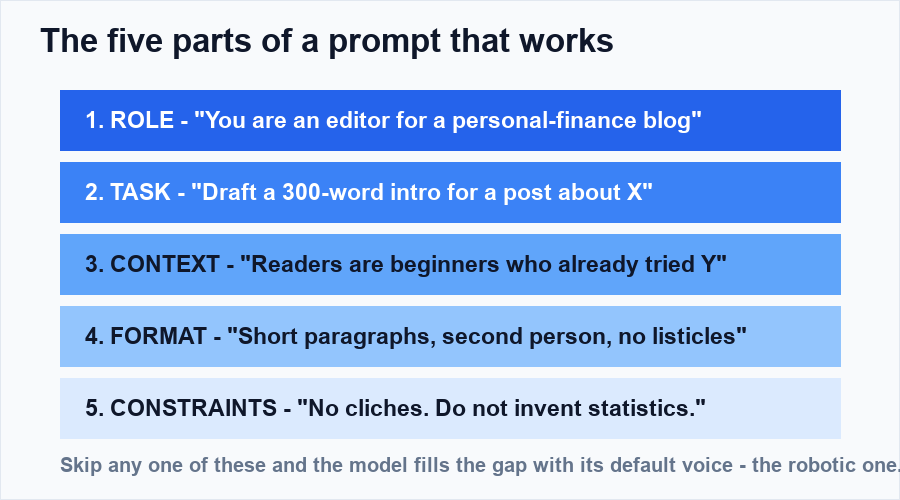
These are the twelve prompts worth stealing, organized by where they fit in the writing process. Each takes the same core idea: give the model a job, a context, and a constraint; then it stops sounding like a machine.
Before writing: research prompts
- “You are a skeptical editor for a [niche] blog. List every objection a first-time reader might have about [topic], ranked by how likely they are to stop reading over it.”, This finds the sections your post actually needs, instead of the sections AI defaults to.
- “Here are summaries of the top 3 articles for this keyword: [paste]. Tell me what all three miss, and what a genuinely better article would include.”, Gap research in thirty seconds. The “what do they all miss” framing works because it forces synthesis, not summarizing.
- “Generate 10 questions my target reader would actually type into Google about [topic], including the awkward ones they’d only ask a friend.”, Autocomplete research on steroids. The awkward ones are your long-tail keywords.
While drafting: structure prompts
- “Here are my raw notes: [paste]. Turn them into an ordered outline. Flag any section where my notes are thin and I’d need first-hand experience or data.”, The flagging instruction is the important part: it makes the model show you the holes instead of papering over them with invented filler.
- “Draft this section in 150 words using only my notes. Second person, short sentences. If a claim in the notes is unverified, mark it [CHECK].”, Word limits and the [CHECK] marker together keep the draft honest and human-sized.
- “Explain [concept] three ways: to a beginner, to a practitioner, and to their boss who approves the budget.”, You keep the version that matches your reader; the other two usually sharpen your own understanding.
- “Suggest 3 analogies from cooking, carpentry, or gardening that explain [technical concept] without being corny.”, Analogies are the most human thing in writing and the thing raw AI output most lacks.
While editing: voice prompts
- “Critique this intro like an editor who has read 500 posts today. What sentence makes them close the tab?”, This one stings, and that’s the point. It reliably catches the throat-clearing first paragraph that AI (and tired humans) love.
- “Rewrite this paragraph so a smart 13-year-old could follow it, without dumbing down the terminology.”, The compression pass. Every post gets shorter and clearer.
- “Here are 5 headings I wrote. Make each one more specific without adding hype words or numbers I can’t back up.”, Specificity without clickbait, in one instruction.
Before publishing: packaging prompts
- “List every factual claim in this draft that needs a source, as a checklist.” (This is the pre-flight check. Anything on that list either gets verified or deleted) no exceptions.
- “Compress this post into a 5-tweet thread, one idea per tweet, no hashtags, no ‘thread’ emoji.”, Distribution, done in the same sitting while the ideas are fresh.
The rule that makes all twelve work
Every prompt above treats the AI as a research assistant, not an author. The model drafts, you decide. That distinction is also exactly what Google’s guidance rewards; helpfully, their systems judge the output, and output shaped by your experience reads like you. When the draft is done, run it through the 10-minute fact-check routine before publishing, and if you want to compare the top AI models and coding assistants for your workflow, explore our AI Tools & Autonomous Agents Directory.
What never to ask an AI to do
Three requests break trust no matter how good your prompts are: “write my whole post” (you’ll publish something with no experience in it), “give me statistics” (models produce plausible numbers, not real ones; this is the single most common hallucination trap), and “what are [product]’s current features?” (training data lags reality; pricing and settings go stale fast). Use the prompts above for thinking and shaping. Use your own eyes; and the fact-check routine; for anything a reader could repeat as true.
Build your prompt library
The compounding move is small: every time a prompt produces a genuinely good result, save it in a doc with one line about why it worked. Within a month you’ll have twelve to twenty proven prompts tuned to your niche and voice; at which point AI stops being a slot machine and becomes infrastructure. Revisit the library monthly; retire the ones that stopped earning their place. Twelve good prompts, kept honest, beat four hundred you scroll past.
Frequently Asked Questions
Will Google penalize me for using AI?
Google judges the output, not the tool; helpful, accurate content passes regardless of how it was drafted, and unedited filler fails regardless of prompt quality. The routine above plus your own experience is what keeps you on the right side of that line.
Keep going: prompts get the draft moving; the 10-minute fact-check routine is what makes it publishable, and this guide to AI content that survives Google explains the line between the two.