

Someone on YouTube claims $40 RPM. A forum post next to it says $2. Both are telling the truth, which is exactly why AdSense RPM confuses every beginner: the number depends on your niche, your reader’s country, the month, and decisions you haven’t made yet.
Here’s what RPM actually is, what realistically moves it, and the ranges you should expect, so you can model your income without either the hype or the doom.
What RPM actually is (and isn’t)
RPM (revenue per mille) is your estimated gross earnings per 1,000 pageviews. Two traps hide in that sentence. First, gross: the number AdSense shows you is before Google’s revenue share, which is 68% for content ads. Second, it’s per pageview, not per visitor; person viewing three pages counts three times, so “pageviews” is the denominator that matters for your math.
The formula, if you want to sanity-check a claim: RPM = earnings ÷ pageviews × 1,000. If a site earned $420 from 35,000 pageviews, that’s an RPM of $12, and about $285 after the revenue share.
What actually moves the number
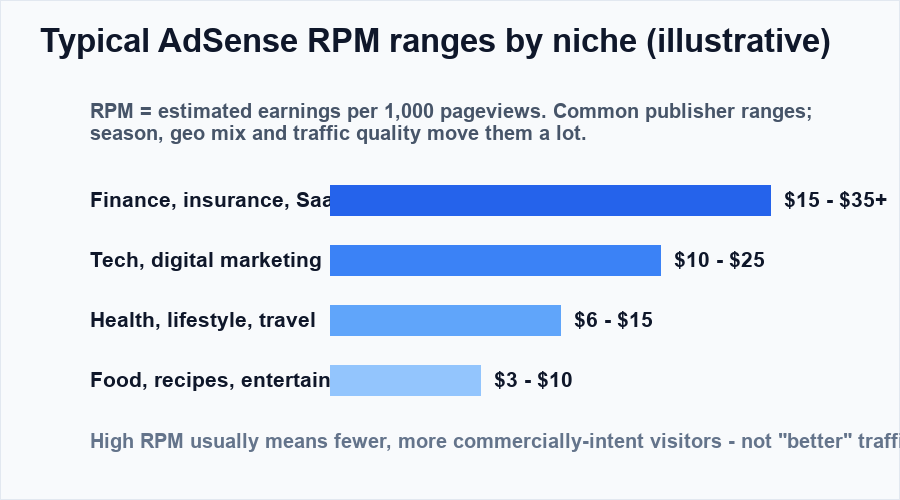
- Advertiser demand for your niche. Insurance and software companies bid more than recipe readers. This is the single biggest factor; it’s why the chart above has a 5× spread.
- Where your readers live. A thousand pageviews from the US, UK, and Canada can out-earn five thousand from low-CPM regions. Same content, different RPM, purely because of who’s reading.
- The season. Q4 (October-December) is always the strongest; advertiser budgets peak for the holidays. January is historically the dip. Plan cash-flow around it.
- Your ad layout. More units and better placement raise RPM, up to the point where they wreck the reading experience and traffic quietly decays. The sweet spot: ads after the intro, mid-content, and end of post. Not eight units crammed above the fold.
The math that matters for a $1,000 month
Work backwards from an honest RPM. At $12 RPM (reasonable for a tech/marketing blog with mostly-US traffic), $1,000/month needs about 83,000 pageviews. At $6 RPM (lifestyle niche), that’s 167,000. The lesson isn’t “AdSense is bad”; it’s that display income is a volume business, and it should be paired with affiliate income that scales differently. That comparison is its own post: AdSense vs affiliate marketing.
What raises RPM (and what just feels productive)
Writing content that sits next to commercial intent is the real lever; post comparing two hosting plans earns more per view than a news roundup, because advertisers bidding on hosting keywords follow the reader. Placement tuning helps too, in small steps. What doesn’t work: clicking your own ads (permanent ban, no appeals), “high RPM niche” pivots into topics you can’t genuinely write about, and squeezing in a fifth ad unit after four already hurt scroll depth.
Before any of this matters
You need to be approved first; and the fastest route through that process is our AdSense approval checklist, which covers the legal pages, content depth, and technical setup reviewers actually check. Once you’re approved and ads are live, give placement decisions two full weeks before judging them: RPM swings wildly in the first month as Google’s ad targeting learns your audience.
Pageviews, visitors, sessions: The denominator trap
RPM math only works when you know what’s being divided. A visitor is a person; a session is one visit (which may include many pageviews); a pageview is every page loaded. AdSense RPM uses pageviews, so a reader browsing five posts counts five times, which is why “engaging archives” quietly out-earn “one great landing page” in display terms. When someone quotes an RPM, always ask: per what?
What the first month actually looks like
Expect chaos, in a good way. AdSense’s targeting takes two to four weeks to learn who your readers are, so early RPM swings ($4 one week, $18 the next) are normal and mean nothing. Resist redesigning your ad layout in week one. Compare months, not days, and change one variable at a time so you can actually attribute what moved.
Traffic quality beats traffic size
Two sites with identical pageviews can differ 4× in RPM purely because of who reads them. A US-heavy audience in a commercial niche out-earns a global audience reading casual content; same effort, different paycheck. This isn’t an argument to abandon topics you love; it’s an argument to know your mix. If 70% of your traffic is from low-CPM regions, affiliate income and digital products (which don’t care about geography) deserve more of your attention than ad placement tweaks.
Frequently Asked Questions
Is AdSense still worth it in 2026?
As a floor, yes; it’s the only stream that pays from your very first pageviews with zero audience trust required. As a ceiling, no: at realistic traffic levels it should be one layer, not the plan. The strategic comparison is in AdSense vs affiliate marketing.
Does ad placement really change RPM that much?
Yes; moving from a single sidebar unit to three in-content placements (after intro, mid-post, end) typically moves RPM 30-60%, because in-content views are the ones advertisers pay for. Beyond four units, you’re usually trading scroll depth for pennies.
Keep going: approval comes first; the AdSense approval checklist covers it end to end; and once ads are live, the strategic comparison is AdSense vs affiliate marketing.