
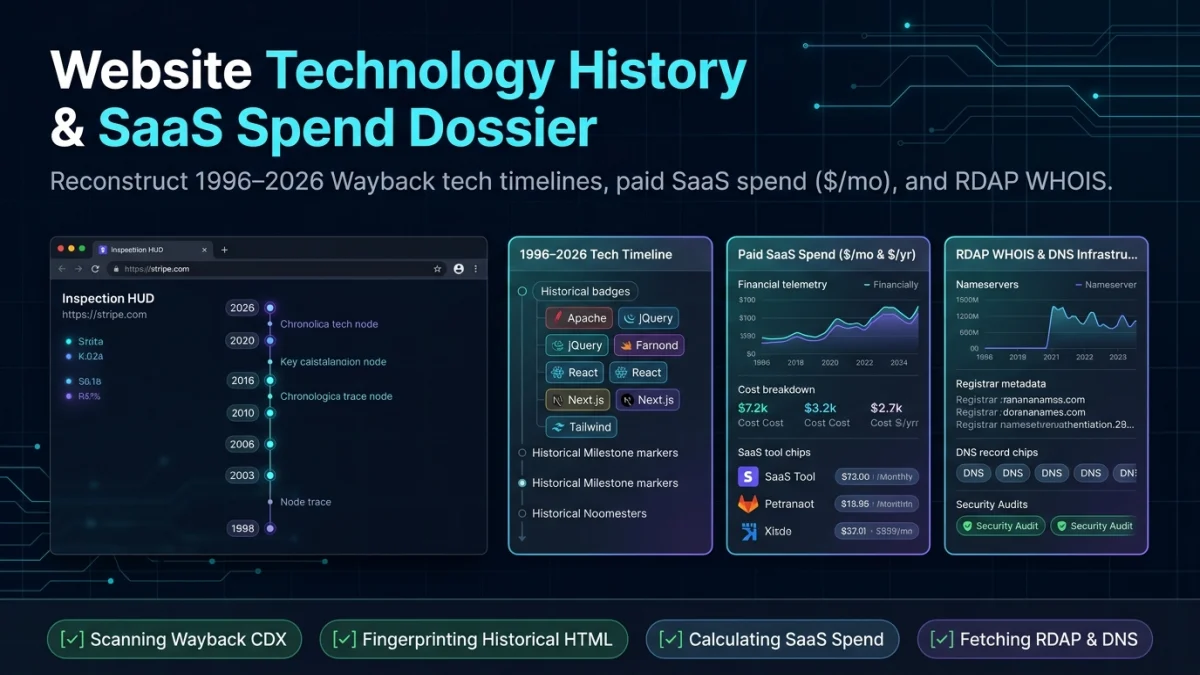
When researching a competitor, evaluating an acquisition target, or pitching a web engineering client, knowing what technology a website uses today is only half the story. The deeper strategic advantage lies in knowing when they migrated platforms, which analytics or marketing tools they recently adopted or abandoned, and how much they spend every month on commercial SaaS infrastructure.
Historically, accessing multi-decade technology timelines and SaaS spend telemetry required enterprise intelligence subscriptions like BuiltWith Pro or Wappalyzer ($295–$995/month). To make this data accessible to every developer, founder, and SEO strategist, we engineered the free GrowthNiq Website Technology History, WHOIS & Paid Spend Dossier.
1. How Multi-Decade Website Technology History Tracking Works (1996–2026)
A standard live scanner only inspects a domain’s current HTTP response headers and DOM. By contrast, the Website Intelligence Dossier combines real-time production stack fingerprinting with chronological snapshots from the Internet Archive Wayback Machine CDX Index (1996–2026):
- Wayback CDX Timeline Sampling: The engine queries historical captures across every year a domain has been active on the web, identifying its earliest archived footprint and total capture density.
- Historical HTML & Script Fingerprinting: Multi-era snapshots are inspected for historical CMS signatures (WordPress, Shopify, Magento, Webflow, Drupal, Ghost), frontend frameworks (Next.js, React, Vue, Nuxt, Astro, Tailwind CSS, Bootstrap), and analytics pixels (Google Analytics, Segment, HubSpot, Intercom, Stripe).
- Release-Year Verification Guards: Every detected technology is cross-checked against its actual initial release year so modern frameworks never produce false-positive pre-release dates on legacy domains.
2. Real-World Case Study: 2026 Tech Stack & Estimated SaaS Spend Benchmarks
Using live data from the GrowthNiq Website Tech History & Spend Dossier and the Website Theme & CMS Detector, here is how five major web platforms compare across architecture, historical archive span, and estimated commercial software spend:
| Domain | Core Platform & UI Stack | Wayback Span | Est. Monthly Stack Spend | Live Dossier Link |
|---|---|---|---|---|
| stripe.com | Custom Web App (Next.js / React / Markdoc) | 1998 – 2026 | Enterprise Custom ($1,200+/mo) | Inspect Stripe Dossier → |
| shopify.com | Shopify Hydrogen & React SSR + Cloudflare Edge | 2005 – 2026 | Enterprise Cloud ($950+/mo) | Inspect Shopify Dossier → |
| vercel.com | Next.js App Router + Geist Design System | 2016 – 2026 | Enterprise Edge ($600+/mo) | Inspect Vercel Dossier → |
| elementor.com | WordPress + Hello Elementor + Cloudflare WAF | 2016 – 2026 | Commercial WP Stack ($450+/mo) | Inspect Elementor Dossier → |
| yoast.com | WordPress + Yoast Enterprise SEO + Cloudflare | 2007 – 2026 | Commercial WP Stack ($400+/mo) | Inspect Yoast Dossier → |
3. How Commercial SaaS & Infrastructure Spend Is Calculated
Most websites run a hybrid stack of free open-source software (such as WordPress Core, React, Tailwind CSS, or Let’s Encrypt TLS) alongside paid commercial subscriptions (such as Shopify Plus, Kinsta or WP Engine managed hosting, Cloudflare Enterprise WAF, HubSpot Marketing Hub, Intercom, or Segment).
When you scan a domain in the Website Intelligence Dossier, our pricing telemetry engine categorizes every detected item into four transparent tiers:
- Enterprise Tier (
$$$): Mission-critical enterprise platforms, custom cloud hosting, and advanced customer data platforms ($200 to $2,000+/month). - Commercial Pro Tier (
$$): Paid SaaS subscriptions, managed WordPress/cloud hosts, premium analytics, and commercial plugins ($29 to $199/month). - Freemium Tier (
$): Tools with free entry tiers and paid usage scaling (such as Cloudflare CDN, Google Tag Manager, or Sentry). - Free & Open-Source (
Free): Open-source core frameworks, libraries, and standards ($0/month).
4. Authoritative IANA RDAP WHOIS, Subdomain & DNS Lifecycle Auditing
Unlike legacy scrapers that rely on cached third-party WHOIS databases, GrowthNiq queries authoritative IANA RDAP (Registration Data Access Protocol) registries and Port-43 WHOIS servers directly, alongside live DNS resolution:
- Domain Registration Lifecycle: Exact registration date, last updated timestamp, expiration date, domain age in years, registrar name, and ICANN EPP status locks (
clientTransferProhibited). - Live DNS & Email Security Posture: Full
A,AAAA,NS,MX,TXT,CAA,SPF, andDMARCrecords, plus Certificate Transparency (CT) active subdomain discovery.
5. Step-by-Step: Run Your First Free Website Intelligence Audit
- Open the Website Technology History, WHOIS & Paid Spend Dossier.
- Enter any root domain (for example,
stripe.com,openai.com, or your competitor’s domain) and click Generate Dossier. - Review the Technology Profile tab for First-Detected and Last-Detected Wayback dates, switch to the SaaS Spend & Budget tab to inspect monthly/annual cost breakdowns, or click Export CSV / Print PDF to save an executive report.
Need to inspect active WordPress plugins, child themes, or reverse-search 110M+ domains by technology? Combine the Dossier with our Live Website Theme & CMS Detector and Reverse WordPress Theme & Plugin Websites Finder.